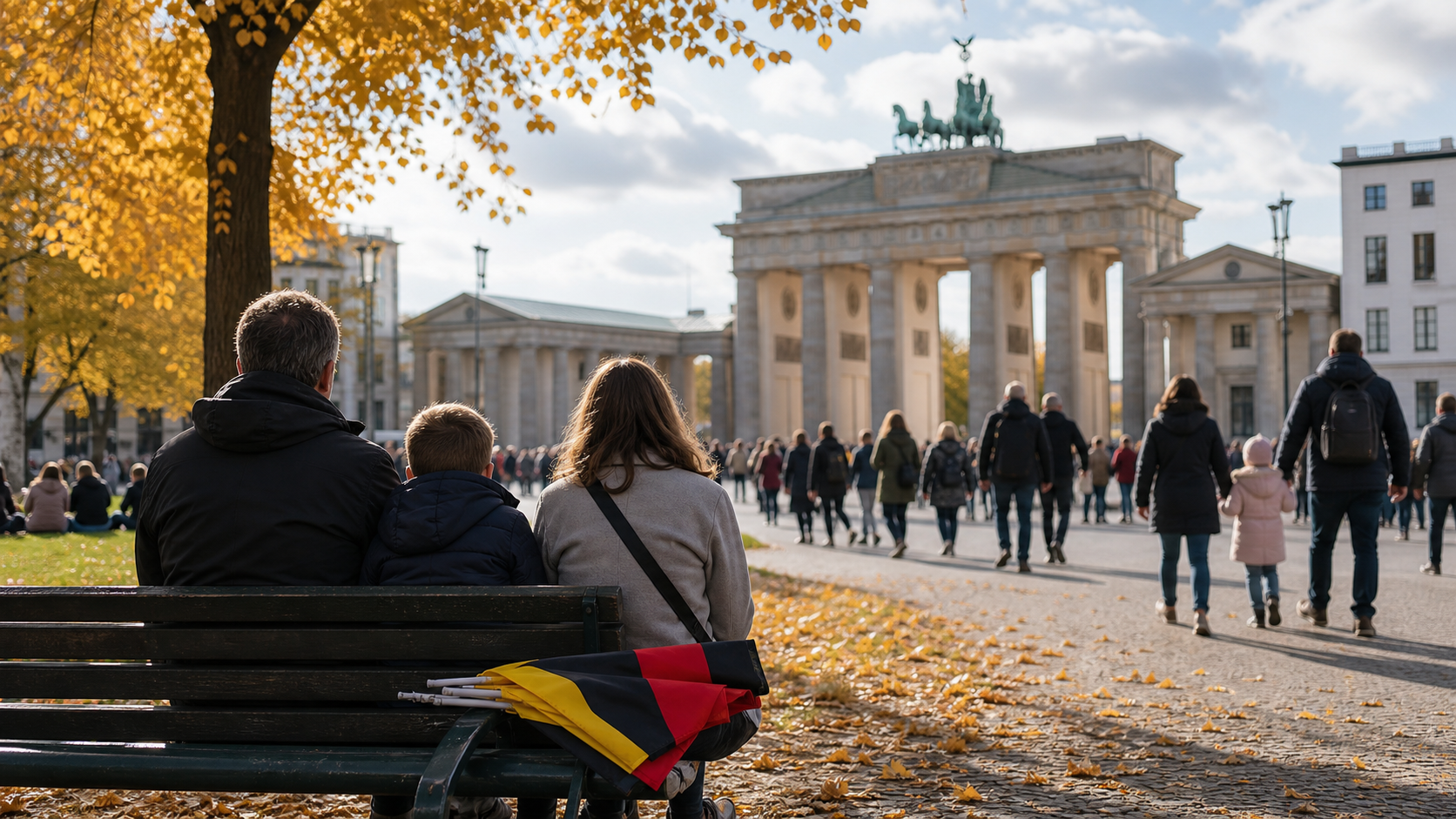
Berlin autumn city scene on German Unity Day

German Unity Day

Public holiday Nationwide Falls on Saturday

German Unity Day on 3 October is Germany's nationwide national holiday. The legal status is simple; the practical effect comes from unity celebrations, city traffic, autumn school-break proximity and the weekday position.

Author
Brückentage-Planer.de editorial team
Last checked
Source basis
official sources and editorial review
Overview

At a glance

What the Saturday national holiday means for work, autumn school breaks and local events.

Date
German Unity Day falls on Saturday in 2026.
Status
Nationwide
Nationwide public holiday on 3 October.
Applies in
nationwide
Article 2 of the Unification Treaty fixes 3 October as the statutory national holiday. The Saturday date in 2026 does not produce a substitute Monday.
Planning cue
Check surrounding days
Check the Saturday date, autumn school breaks and the local programme separately.

Article 2 of the Unification Treaty fixes 3 October as the statutory national holiday. The Saturday date in 2026 does not produce a substitute Monday.

3 October applies in every German state. In 2026 it falls on Saturday and is not moved to Monday, so a standard five-day schedule gains no additional weekday off.

Its practical effect depends more on place: unity celebrations, museums, remembrance sites, security areas and public transport publish their own programmes and notices.

Leave calculation

Bridge days and leave

Weekend position, autumn breaks and city traffic

Read 3 October with its Saturday position, local celebrations, published transport notices and autumn school breaks. The day is free nationwide; specific programmes remain local.

In 2026, 3 October falls on Saturday and is not moved to Monday. A longer break therefore needs Friday or Monday leave.

Before a city trip, check the event venue, closures, destination hours and the specific rail service.

For teams, the date is easy to mark nationwide; leave days beside it should still be shown separately.

3 October 2026 falls on a Saturday. For a normal Monday-to-Friday week, that creates no additional Monday off; 5 October remains a normal working day in principle.

Anyone wanting a long weekend must consider leave on Friday, 2 October or Monday, 5 October. That leave is a separate decision, not a substitute holiday.

Practice

Everyday rules

Article 2 of the Unification Treaty fixes 3 October as the statutory national holiday. The Saturday date in 2026 does not produce a substitute Monday.

Work

Saturday, no substitute

German Unity Day falls on Saturday 3 October in 2026. It adds no weekday off to a standard Monday-to-Friday schedule; Friday or Monday leave creates a three-day break.

School and family

Check autumn break

The nationwide holiday does not answer whether 2 or 5 October is inside a school break. Use the KMK calendar for the relevant state.

Local service

Use the actual event site

Official ceremonies and local programmes can change journeys on 3 October. For 2026, check the chosen city's published venue and transport information.

Published hours

Not an ordinary Saturday

Do not plan 3 October as a routine shopping Saturday. Station outlets, emergency pharmacies, hospitality and events must be checked against their specific published arrangements.

Authorities, many shops and schools follow the public-holiday schedule on 3 October. The following Monday returns to normal opening and working hours unless autumn breaks or workplace rules say otherwise.

For an event, use the city's own information for security zones, admission, museum hours and transport. A nationwide holiday does not create one nationwide programme or opening time.

Visitors near Brandenburg Gate on German Unity Day
Legislation

Legal context

Assess nationwide public-holiday status separately from an individual's Saturday rota.

2026 status

Nationwide public holiday on 3 October.

Pay and rota

Because the holiday falls on Saturday in 2026, section 2 of the Continued Remuneration Act matters only where Saturday would have been a scheduled workday. Holiday duties also require the rota and section 9 of the Working Time Act.

Adjacent workdays

For a standard Monday-to-Friday schedule, 2026 brings no additional weekday off; Friday or Monday requires approved leave.

German Unity Day is a statutory public holiday in every German state. Its nationwide scope is independent of the location of the central ceremony or a local civic festival.

When the holiday falls on a Saturday, Germany has no general automatic substitute holiday on Monday. Work and school planning must therefore use the actual date.

Scope

States and scope

Nationwide day off, local events

The public-holiday status applies across Germany. Applicable holiday rules and published exceptions govern specific workplaces, schools, public offices and providers.

Differences come from published events, security zones, local transport information and museum hours.

For travel and planning, the specific city or region matters beside the holiday itself.

Historical context

Reunification and 3 October

From divided Germany to unity on 3 October

German Unity Day commemorates German state unity in 1990. After decades of division, 3 October marks the completion of the political unification process.

Article 2 of the Unification Treaty designates 3 October as German Unity Day and a statutory public holiday. The national holiday therefore has a clear federal legal basis.

Its historical meaning extends beyond a day off. Museums, remembrance sites and civic-education programmes can examine division, the Peaceful Revolution and reunification from different perspectives.

3 October recalls Germany's state unity in 1990 and marks the conclusion of the political reunification process.

The historical meaning can be explored through central ceremonies, museums, memorials and local educational programmes from different perspectives. No single venue represents the whole history.

Programme

Unity celebrations, museums and remembrance

The central celebration and local programmes

The central unity celebration and many local programmes give the national holiday a specific venue each year. Travel planning should therefore use the event that has actually been published, not a blanket assumption about Berlin.

Cities may offer stages, exhibitions, civic festivals or commemorative events. Anyone attending should check the programme, admission, security area and journey directly with the relevant organiser.

The historical context is also accessible without a major event: museums, memorials and local remembrance sites set their own hours and focus. Public-holiday status does not guarantee admission to every destination.

FAQ

Questions about German Unity Day

Nationwide status, 3 October, the Saturday date and local celebrations.

Is German Unity Day a nationwide public holiday?

Yes. 3 October is a statutory public holiday in every German state.

Why is German Unity Day celebrated on 3 October?

3 October commemorates German state unity in 1990. Article 2 of the Unification Treaty designates the date as German Unity Day and a statutory public holiday.

Is there a substitute Monday in 2026?

No. The holiday falls on Saturday in 2026 and is not moved. A free Friday or Monday requires approved leave or another form of time off.

What should I check for a unity celebration?

Use the published venue, admission and security notices, possible closures, local transport and the opening hours of the chosen destination.

Next steps

Plan next

Bring together the Saturday date, approved leave, autumn school breaks and the actual unity programme.

Mark 3 October 2026 as the nationwide Saturday holiday, and add Friday or Monday as free only when leave has been approved. Autumn school breaks belong in the plan as a separate calendar.

For a city trip, add the local layer next: venue, admission, possible closures, museum hours and the rail service. Calendar subscription and export can keep the holiday, leave days and other autumn dates together.

For a trip, choose a specifically published event or museum and check its programme, admission, security area and route with the organiser.

Keep Saturday as the public holiday and the following Monday as a normal working day. That prevents autumn breaks, leave and the return journey from being mistaken for a substitute rule.

Sources & further reading

  1. Unification Treaty Article 2 : Federal legal basis: 3 October is German Unity Day.
  2. bpb on German Unity Day : Historical context for reunification and 3 October.
  3. KMK holiday calendar downloads : School-break downloads for calendar comparison.
  4. Reformation Day (31 October) : The regional holiday before All Saints' Day in several northern and eastern states.
  5. All Saints' Day (1 November) : The quiet regional holiday directly after Reformation Day.
  6. World Children's Day (20 September) : The Thuringian family-focused holiday with school and childcare relevance.
  7. Working Time Act section 9 : Federal rule for Sunday and public-holiday work exceptions.
  8. Continued Remuneration Act section 2 : Pay rule after statutory scope is established.